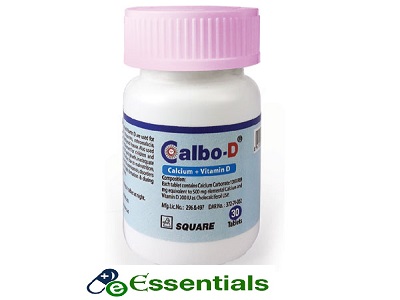
Composition Each tablet contains- Calcium Carbonate 1250 mg equivalent to 500 mg elemental Calcium and Vitamin-D 200 I.U. or 400 I.U. as Cholecalciferol Or Calcium Carbonate 1500 mg equivalent to 600 mg of elemental Calcium Vitamin D3 (Cholecalciferol) 400 IU. Indications Calcium Vitamin D3 is used to prevent or treat low blood Calcium levels in people who do not get enough calcium from their diets. This is used for the treatment and prevention of the following conditions: Osteoporosis Osteomalacia Rickets Tetany Hypoparathyroidism Pre-eclampsia during pregnancy Premenstrual syndrome (PMS) Post-menopausal osteoporosis This is also used as supplement in the following conditions: Pregnancy & lactation Elderly patients Inadequate intake of Calcium in childhood Therapeutic Class Specific mineral & vitamin combined preparations Pharmacology Calcium is used as a pharmacological agent in humans almost entirely to remedy deficiency. Adequate calcium in the blood is so vital to a wide variety of bodily functions that our internal biochemistry will not tolerate a deficiency even for short periods. Clinical evidence suggests that calcium is useful for the prevention and treatment of osteoporosis and associated fractures. Vitamin-D is also essential for health bones as it aids in calcium absorption from the GI tract. In addition to this it stimulates bone formation . Clinical studies show that calcium and vitamin-D has synergistic effects on bone growth as well as in osteoporosis and fracture prevention . Dosage & Administration Calcium 500 mg and Vitamin D3 200 IU Tablet: 2 tablets daily or 1 tablet twice daily. It is best taken with or just after a meal to improve absorption. Calcium 500 mg and Vitamin D3 400 IU Tablet: 1 tablet twice daily. It is best taken with or just after a meal to improve absorption. Interaction Concurrent administration of Thiazide diuretics may increase the risk of hypercalcemia. Calcium salts reduce the absorption of a number of other drugs such as Biphosphonates, Fluoride, some Fluoroquinolones and Tetracyclines. Contraindications Hypersensitivity to any component of the product. Hypercalcaemia for example, as a result of hyperparathyroidism, vitamin D overdose, decalcifying tumours scuh as myeloma, bone metastases or sarcoidosis. Severe hypercalciuria, renal stones. Osteoporosis due to immobilization. Side Effects Most common side effects are flatulence, diarrhea, constipation, upper GI discomfort etc. Hypercalciuria and hypercalcemia due to prolong use has rarely been reported. Pregnancy & Lactation Normal requirements of calcium & vitamin D are raised during pregnancy & lactation. Calcium is excreted in breast milk but not sufficiently to produce adverse effect in the infant. Allowance should be made for vitamin D / calcium for other sources. Precautions & Warnings Caution should be taken in patients with Renal impairment, Sarcoidosis, Hypercalcemia and Hypercalciuria, Cardiac disease. Storage Conditions Store in a cool and dry place. Keep out of the reach of children. Protect from light.